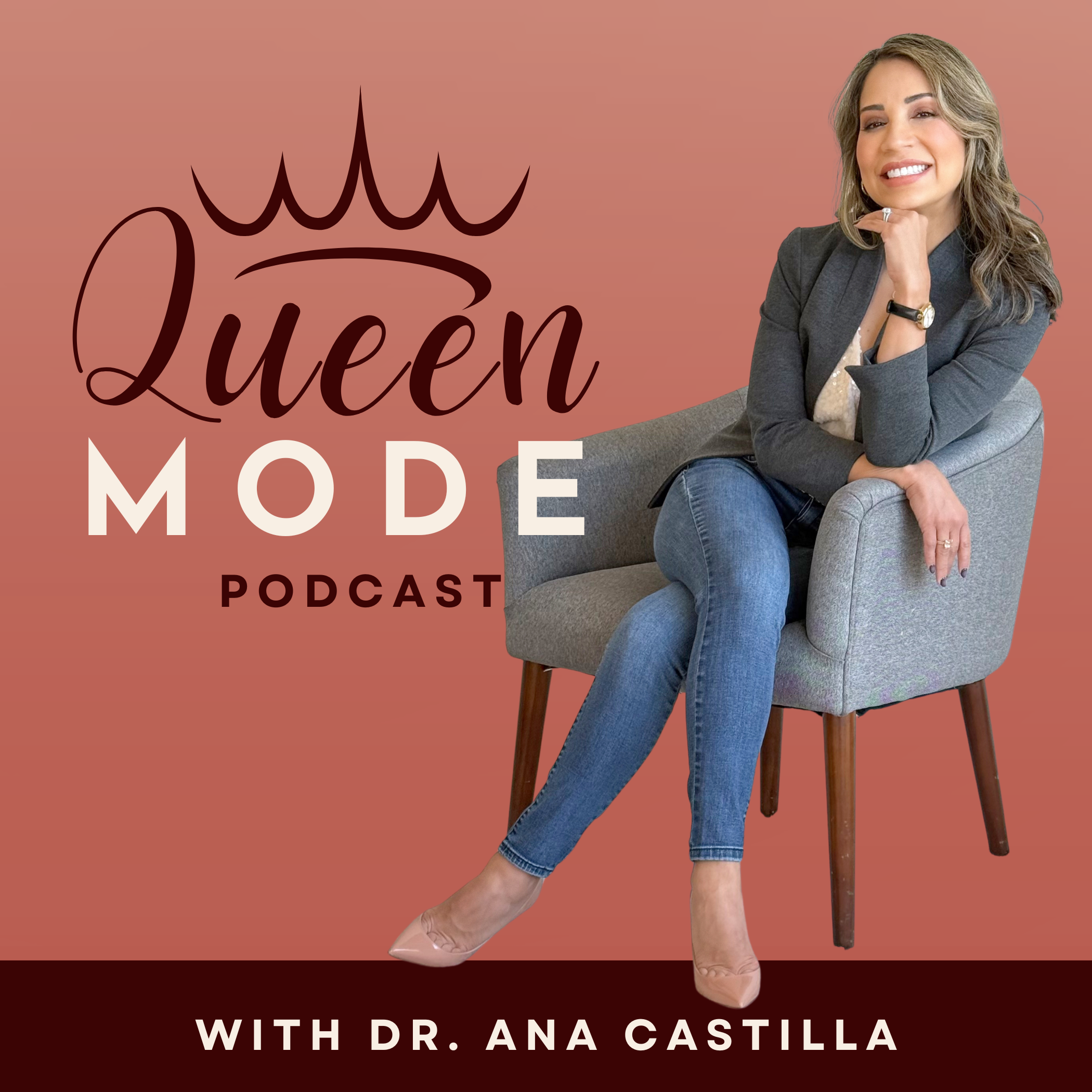
From Operator to Visionary: The Hire That Frees You to Scale
You built the empire — but does your business feel like a kingdom or a cage? If every decision still runs through you, the 9 PM Slack pings never stop, and you cannot fully unplug on the weekend, you do not actually own a company. You own a very high-paying, high-stress job.
In this episode of QueenMode, Ana breaks down the transition every 6 and 7-figure founder must make to scale cleanly: moving from frantic operator to regulated visionary. She introduces her proprietary Vision-to-Ops Bridge — a 3-step system (Audit, Align, Authorize) for transferring authority and institutional knowledge from your brain to your first high-level operations hire — and walks you through the 7-day calendar audit, the Integrator Success Profile, Decision Guardrails, and the 90-day Logic Transfer that protects your genius and frees your empire to grow.
What You'll Learn
- Why hiring "helpers" keeps you stuck and what to hire instead so your business can finally outgrow your nervous system
- The Vision-to-Ops Bridge: the 3-step framework (Audit, Align, Authorize) for installing your first true operational leader
- How to use the Rule of Three and the Delete / Delegate / Design filter to identify the work only you can do
- How to set Decision Guardrails so your right hand can lead without you — and the 90-day Shadow, Reverse-Shadow, Total Ownership transfer that makes it stick
Key Quote
"You aren't hiring a right hand to do your work; you're hiring them to protect your genius."
If this episode hit home, share it with a woman entrepreneur who needs to hear it.
Leave a review to help more ambitious women find QueenMode.
Ready for CEO-level strategy? DM "ADVISORY" to @dranacastilla on Instagram for info on The Queen Client Private Advisory.
Follow @queenmodepodcast on Instagram.
Listen now on Apple Podcasts, Spotify, or YouTube Music.
Transcript
I want you to think about the moment you realized you had finally made it.
2
:Maybe it was the month you hit multiple six figures or that first seven figure year.
3
:You built the empire.
4
:But let me ask you very honest question.
5
:Does your business feel like a kingdom or does it feel like a cage?
6
:Because I know what it feels like to technically own the business and still feel trapped
by it.
7
:To be the one answering everything, deciding everything, carrying everything.
8
:It's the 9 p.m.
9
:Slack pings, the weekend you cannot unplug, the exhausting reality that everything still
runs through you.
10
:Here is the mic drop refrain.
11
:Your business cannot outgrow your capacity to delegate.
12
:If you are the only one who can solve the problems, you do not actually have a company.
13
:You have a very high paying, high stress job.
14
:You may be the strongest pillar in the business, but you are also the ceiling.
15
:Today we are breaking that ceiling.
16
:It's time to stop laying every brick and start leading the empire.
17
:What's up Queen?
18
:I'm Dr.
19
:Ana Castilla, orthodontist, entrepreneur, business coach, author, speaker, unapologetic
dream chaser, and yes, I took my business from flatlining to an eight figure exit in just
20
:eight years.
21
:But spoiler alert, I didn't get there by playing it safe.
22
:I broke rules, I made bold moves, and I became the woman my younger self was waiting for.
23
:Queen Mode is your weekly dose of fear strategy, unfiltered truth, and mindset shifts that
will have you leading, growing, and living like the powerhouse you are without burning out
24
:or selling out.
25
:So if you're done playing small and ready to rise, welcome home.
26
:Let's talk about the operator trap.
27
:And I want to personalize this for a moment because I lived through this.
28
:When I first bought my practice, I thought owning the business meant running the business.
29
:I thought that being the owner meant I was supposed to do all the things.
30
:I was still thinking like an employee, just with more pressure and a lot more risk.
31
:I now see there were really three stages.
32
:First, admin mode, then operator mode, then true business owner mode, or as I like to call
it, queen mode.
33
:And a lot of women never make that final jump.
34
:Most six and seven figure entrepreneurs are brilliant at execution.
35
:That's how you got here.
36
:You are talented.
37
:You are resourceful.
38
:You are a doer.
39
:But the very skills that got you to seven figures are the exact skills that will keep you
stuck there.
40
:When you remain in the weeds of daily execution, you are participating in business by
accident.
41
:You are reacting to the loudest fire instead of designing the future.
42
:There is a hidden cost to your self-reliance.
43
:When you insist on being the smartest person in the room, when every decision must run
through your brain, you are effectively stunting your team's growth.
44
:You are training them to be order-takers, not leaders.
45
:And the cost to you?
46
:It's decision fatigue.
47
:Have you ever looked at your screen at 3 p.m.
48
:and felt like you had too many tabs open in your brain to even think about your high level
strategy?
49
:That's because your brain is currently being used to solve low value problems.
50
:In the beginning of my practice, I was doing bookkeeping.
51
:I was paying bills.
52
:I was making entries in QuickBooks.
53
:I was reconciling accounts.
54
:And the craziest part?
55
:At one point, I barely even knew how things were actually being done in the office.
56
:I remember a consultant asking me if I had a new patient phone slip, which is a new
patient intake form.
57
:And I honestly didn't know.
58
:That is how disconnected a founder can become when she is buried in the wrong work.
59
:Why are you hiring helpers instead of leaders?
60
:Most queens think they need an assistant to take things off their plate, but an assistant
still requires you to be the brain.
61
:You are still the one telling them what to do.
62
:To truly scale, you don't need another pair of hands.
63
:You need another brain.
64
:You need a second in command who can take ownership.
65
:And let me be clear, this does not mean every woman listening needs to go hire a full-time
director of operations tomorrow.
66
:it does mean you need to stop normalizing being the permanent bottleneck.
67
:The earlier you learn the difference between founder work and operator work, the faster
you scale cleanly.
68
:We are moving into business by design, where your leadership is about setting the vision,
not managing the minutiae.
69
:And for those of you thinking, well, my business is too small for this.
70
:No, this conversation is not just about the size of your business.
71
:It is about the structure of your leadership.
72
:Whether your first step is a part-time operations person, a contractor, or elevating
someone internally into more ownership, the point is the same.
73
:Operational ownership cannot live in your nervous system forever.
74
:To get you out of the weeds, I've developed a proprietary framework called the Vision to
Ops Bridge.
75
:And here is why this matters so much to me.
76
:When my husband Eddie first came into my practice, I did not hire him with some
sophisticated master plan.
77
:I did not say I need a high level operations leader.
78
:Honestly, I hired him by accident.
79
:I brought him in because I needed help.
80
:I needed someone to help me manage administrative things, finances, HR type issues, and
all the back end weight I was carrying.
81
:But what became clear very quickly was that what I actually needed was not just help.
82
:I needed operational leadership.
83
:This is a three-step system designed to transfer authority and institutional knowledge
from your brain to your first high-level operations hire.
84
:Step one, audit.
85
:We are going to map the CEO only task versus the high value operations task.
86
:You have to know what you're keeping and what you're releasing.
87
:Step two, align.
88
:We are building the integrator success profile to find your opposite.
89
:You don't need a mini you.
90
:You need someone who loves the things you hate.
91
:That was one of the biggest lessons of my own business.
92
:Eddie loved the operational side.
93
:God bless him.
94
:He loved the spreadsheets, the processes, the checklist, the accountability, the redesign
of how the front desk function.
95
:This is a guy who had Excel shortcuts printed on his mouse pad.
96
:He loved the how.
97
:And because he loved the how, I was finally liberated to spend more time in the what and
the why.
98
:Step three, authorize.
99
:This is the most critical step.
100
:We are implementing decision guardrails to ensure your hire has the autonomy to lead
without you.
101
:Because letting go does not mean becoming passive.
102
:It means becoming precise.
103
:You do not hand over the keys blindly.
104
:You hand over responsibility with standards, guardrails, and measurement.
105
:The purpose of this bridge is to allow you to walk away from the daily how so you can
focus entirely on the what and the why.
106
:That is where your true value as a CEO lies.
107
:Queen, your first mission is a seven day time audit.
108
:I want you to track every single thing you do.
109
:Don't judge it, just record it.
110
:At the end of the week, we are going to categorize these tasks into visionary fuel, things
that only you can do that grow the business, and operational friction, things that keep
111
:the business running but drain your energy.
112
:Use the rule of three.
113
:In a healthy seven figure business, there are actually only three things that actually
require your unique DNA.
114
:For me, it was vision, high level strategy, and being the face of the brand.
115
:Everything else is a candidate for the bridge.
116
:And Queen, this is where so many founders get stuck.
117
:They think that if they are still doing the payroll, the bookkeeping, the supply ordering,
the basic team management, the operational follow up, then that means they are being
118
:responsible.
119
:No, it means they are over-functioning.
120
:It means they are stealing visionary capacity from their own business.
121
:Practical exercise here.
122
:Take your list and mark every task with one of three labels.
123
:Delete, Delegate, or Design.
124
:Delete if it shouldn't be happening at all.
125
:Delegate, it's a task for a team member.
126
:for your new high level hire.
127
:Think about this scenario.
128
:How much revenue are you losing right now because you are busy ordering office supplies,
managing basic client pings, or fixing a tech glitch?
129
:If your time is worth $1,000 an hour and you're doing $25 an hour work, you are
effectively stealing from your own empire.
130
:Now we find your match.
131
:You are looking for an integrator.
132
:You are the person with the big ideas and the let's go energy.
133
:You need someone who lives for the how.
134
:You need someone who gets a dopamine hit from a clean spreadsheet and a documented SOP.
135
:When you interview, you aren't looking for task compliance.
136
:You are looking for strategic initiative.
137
:Ask them, tell me about a time you saw a bottleneck in a business and fixed it without
being asked.
138
:That is what I saw happen in my own business.
139
:What started as administrative helped evolved into true operational ownership.
140
:Eddie started building systems.
141
:He started tightening processes.
142
:He started making sure people were actually following the processes.
143
:He started redesigning the mechanics of how the business ran.
144
:That is when I realized I did not just have help.
145
:I had the beginnings of a real operator.
146
:And Queen, sometimes the reason you cannot rise is not because delegation does not work.
147
:It is because you have been trying to build an empire with people who only know how to
wait for instructions.
148
:Some of you do not need more patience.
149
:You need a different caliber of hire.
150
:Once they are in, you must authorize.
151
:This is where most queens fail.
152
:They hire someone brilliant and then micromanage them into a helper role.
153
:You must set decision guardrails.
154
:These are the dollar amounts or impact levels where the hire has total authority.
155
:Script to handover.
156
:You have the authority to solve any operational issue that costs less than $2,000 and
doesn't change our core brand promise.
157
:I only want to hear about it if it breaks our primary systems or exceeds that budget.
158
:Stop the constant pings.
159
:Move to a structured bridge meeting once a week.
160
:This is where you stay aligned without you having to be in the Slack channels all day.
161
:And I want to be very clear about something.
162
:When operations became more fully owned on his side, I was not becoming less valuable.
163
:I was becoming more available for the work that only I could do.
164
:That was the season where I had more capacity to join mastermind rooms, invest in higher
level business education, sharpen strategy, and think more deeply about positioning,
165
:growth, and direction.
166
:That was not a coincidence.
167
:That was leverage.
168
:And yes, I know some of you are thinking, that sounds amazing, Ana, but I cannot afford
that right now.
169
:I hear you.
170
:But the answer is not to keep yourself trapped forever.
171
:The answer is to think in stages.
172
:Maybe your first right hand is not a full-time senior operator on day one.
173
:Maybe it starts part-time.
174
:Maybe it starts project-based.
175
:Maybe it starts by elevating someone already on your team.
176
:The point is not the title.
177
:The point is creating operational ownership outside of you.
178
:I know what you're thinking, Queen.
179
:If I'm not the one solving everything, what is my value?
180
:Or, nobody can do it as well as I can.
181
:Let's reframe that.
182
:And I want to do that by telling you one of my favorite business stories of all time,
which I learned when I first read Think and Grow Rich by Napoleon Hill.
183
:It is a story about the time Henry Ford, as in Ford Motor Company, found himself in a
courtroom after suing a newspaper for calling him ignorant.
184
:The newspaper attorneys wanted to prove Henry was in fact ignorant.
185
:So they interrogated him about US history and they thought they had proved Henry was
ignorant when he didn't know the answers to the questions.
186
:And here's the reason I love the Henry Ford story so much and why it's relevant to this
reframe.
187
:When he was being challenged and questioned, his basic response was, why should I clutter
my mind with every detail when I have people around me who can supply the knowledge
188
:required?
189
:That resonates with me deeply.
190
:By the end of owning my practice, I barely understood how most of the software in the
office worked.
191
:I had no clue how retainers were fabricated.
192
:And sometimes people would realize that and assume that meant I was not the mastermind
behind the business.
193
:They were wrong.
194
:Your value is no longer in your output.
195
:It is in your insight and your direction.
196
:The fact that someone else knows how the machine runs does not make them the visionary.
197
:It makes them the operator.
198
:That distinction matters.
199
:Eddie was extraordinary at carrying out the vision, but I was the one setting the
direction.
200
:I was the one making the strategic decisions.
201
:I was the one deciding what kind of business we were building, who we were serving, where
we were going, and what outcomes mattered.
202
:That is what a CEO does.
203
:You are moving from a worker to a ruler.
204
:And yes, initially they might only do it 80 % as well as you.
205
:But here is the truth.
206
:80 % done by someone else is 100 % better than 100 % done by a burnt out CEO who is about
to quit.
207
:This is an ego trap.
208
:And for some women, it is even deeper than ego.
209
:It is an identity addiction to being needed, to being the fixer, to being the rescuer, to
being the one who holds it all together.
210
:Nobody can do it like me.
211
:It's just a way to keep yourself small and safe.
212
:A high standard shift means you train a leader to uphold your standards, not just copy
your actions.
213
:Being indispensable is not the same thing as being powerful.
214
:Real leadership is not measured by how much collapses without you.
215
:It is measured by what becomes possible because of the vision you set and the leaders you
build.
216
:Validate the fear of a quality drop, then raise the standard.
217
:A true queen trusts her training and her systems more than her own constant intervention.
218
:And let me add this too.
219
:Some of you are telling yourselves that your business is too personal, too custom, too
relationship-driven, too nuanced to hand off.
220
:Yes, there may be parts of your brand, your thought leadership, your client relationships,
and your strategic decisions that should remain deeply founder led.
221
:But that is exactly why everything else cannot stay stuck to you.
222
:And now I want to talk to you about implementing the first 90 days of your operations
right hand.
223
:The first 90 days are about the logic transfer.
224
:And this is where a lot of founders fail.
225
:They either refuse to let go or they dump tasks without transferring the logic.
226
:What actually creates freedom is not handing off random work.
227
:It is handing off responsibility with context, standards, and guardrails.
228
:And if your team is constantly waiting on you, I want you to ask yourself a brave
question.
229
:Have I trained dependents?
230
:Have I punished mistakes
231
:so much that nobody wants to take initiative?
232
:Have I built a business that only works because I over function?
233
:Because if so, that is not just a team issue, that is a leadership pattern.
234
:Phase one is the shadow period.
235
:They watch you make decisions and you document the logic behind them.
236
:Don't just show them what you did, explain why you did it.
237
:Phase two is the reverse shadow.
238
:They make the call and you validate the logic.
239
:You can say, I like that decision.
240
:Walk me through your thinking.
241
:Phase three is total ownership.
242
:They manage the department, you simply receive the data and the results.
243
:What happens when they make their first mistake?
244
:Because they will.
245
:Do not take the reins back.
246
:If you do, you've just taught them that you don't trust them.
247
:Instead, use the post-mortem logic check.
248
:What was the data point we missed?
249
:How do we adjust the guardrails to ensure this doesn't happen again?
250
:Measure their performance based on success profiles, results, and outcomes, not just how
many hours they sat at their desk.
251
:Queen, the transition from frantic operator to regulated visionary is the most important
scale you will ever make.
252
:You aren't hiring a right hand to do your work.
253
:You're hiring them to protect your genius.
254
:For me, that looked like finally having the space to become more fully the visionary
instead of staying trapped as the overextended operator.
255
:And I can tell you from lived experience, when the right operator is in place,
256
:The founder gets to rise.
257
:That is where scale happens.
258
:when you know every detail.
259
:When you lead the direction.
260
:You are the queen and a queen's job is to lead the empire, not to lay every brick.
261
:Audit your calendar this week.
262
:List everything you touched in the last seven days.
263
:Circle the things that only you should own.
264
:Then identify the first function that must move off your plate in the next 90 days.
265
:And then find the first three operational friction tasks that make you want to scream and
decide right now that you will not be doing them six months from today.
266
:You are worth the freedom and your empire requires your vision.
267
:Thanks for tuning in Queen.
268
:I hope today's episode gave you the clarity, courage, or confidence boost you needed
because building a powerful business starts with believing in you.
269
:If you're ready to stop being the bottleneck and start building your seven figure
leadership structure, I'm ready to help you bridge that gap.
270
:DM me at Dr.
271
:Ana Castilla on Instagram with the word advisory to learn about my one-on-one CVP coaching
in the Queen Client Private Advisory.
272
:We will get your strategy, your systems, and
273
:your leadership aligned for the scale you deserve.
274
:Make sure you're subscribed so you never miss a dose of fear strategy.
275
:And if this episode called you forward, leave a review to help another queen rise.
276
:Keep showing up, keep leading boldly, and remember, you were born to reign.